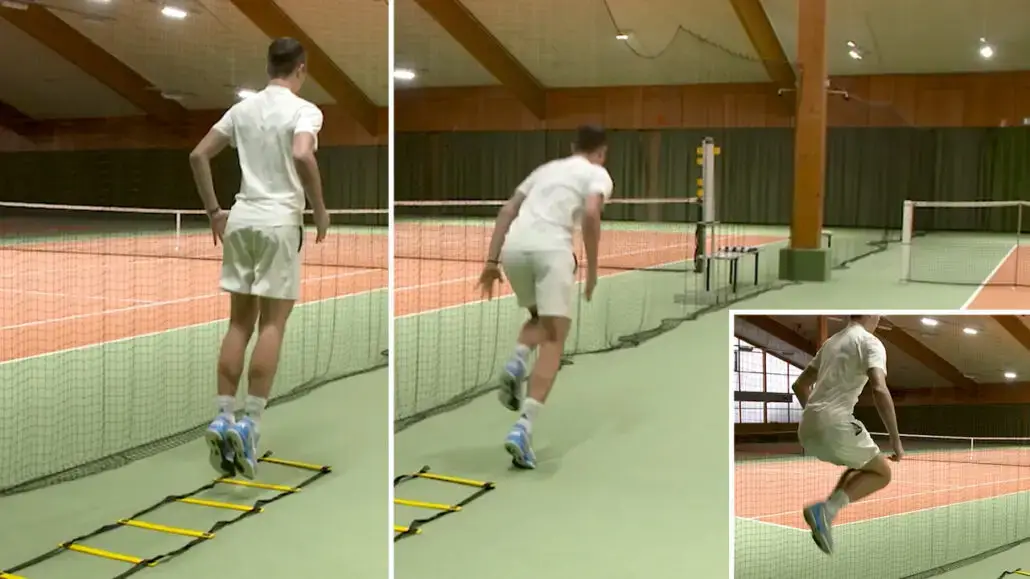
Sprint out of the ladder
The player goes through the ladder in different variations and then smoothly switches to a 10 – 20 m sprint out of the ladder.
Sprint out of the ladder Read More »

The player goes through the ladder in different variations and then smoothly switches to a 10 – 20 m sprint out of the ladder.
Sprint out of the ladder Read More »

The player starts out from different starting positions and tries to accelerate as fast as possible to cover a short distance of about 10 to 20 m (start drills) or 30 to 50 m (sprint drills) in a minimum amount of time.
Different start impulses Read More »

At the acoustic signal, the coach calls A, B, C or D, the player sprints around the indicated cone as quickly as possible and returns to the starting position.
Agility sprint with reaction to an acoustic signal Read More »

At the visual signal, the coach moves the racket in different directions, the player sprints around the indicated cone as quickly as possible and returns to the starting position.
Agility sprint with reaction to racket Read More »

In this game, the players are only allowed to move around the cones with their rackets in front of their bodies to ensure comparability and safety. One player starts while the other player has to sprint around the same cone.
Agility sprint mirroring each other Read More »

The coach gives a visual signal (stroke is moved in one direction). At the signal, the player sprints around the opposite cone as quickly as possible and returns to the starting position.
Agility sprint with visual signal and opposite movement execution Read More »

The coach signals either acoustically (A, B, C and D) or visually (racket is moved in one direction). At the signal, the player sprints around the indicated cone as quickly as possible and returns to the starting position.
Agility sprint with combined signals Read More »

Speed begins with mental processing. A square area is set up with cones in 4 distinct colors. When instructed by the coach, the players must sprint to the cones in a variety of configurations.

These color combinations are designed to engage players in critical thinking before taking action. Players are required to target different small ball can lids using either their foot or hand, with each lid assigned a specific task corresponding to a color.
Thinking and acting through colors Read More »

For this task, we need two benches (or more for additional players), colored marker cones and a ball for the middle. Two players stand opposite each other.
Grabbing cones with movement task as a competition Read More »

Upon receiving instructions, the children swiftly navigate around the cones, exhibiting a burst of energy when altering their course.
Reversal of movement with one-handed throw around the bar Read More »

In this exercise, we focus on balance and strengthening the ankle joint. Our player practices his stability by performing various tasks on the balance plate.
Improve foot stability on the balance plate Read More »

The player uses elastic bands and takes large sideways steps while keeping the body low to the grounds. The movements should be slow and deliberate.
Monster Walk Side-Steps Read More »

Players should be able to rotate their torso while moving in all different directions. That is what modern tennis requires. Here you will see the coaches working on this skill.
Rotational Throw with a Cognitive Component Read More »

Players get on their knees with both arms on the ground in an abbreviated push up position.
Explosive Push ups Read More »

This is a great drill to work on footwork and can be used as a warm up, as a way to strengthen or as a tool to improve the anaerobic capacity of a player. A bouncing medicine ball is ideall for many drills requiring catching and throwing.
Footwork with Medicine Ball Read More »

The coach rolls a tennis ball to the student with the hand. The player rolls it back. To intensify the game, the coach rolls the next ball right as the player rolls other one, usually when the student first makes ball contact. First side to side and then randomly. Important: a low center of gravity and a straight back.
Down with the Body Read More »

The player starts on the baseline and sprints forward to the dervice-line, then backward back to the baseline, forward again to the net and finally forward back to the starting position.
Forward and backward sprint Read More »

This exercise targets the shoulder external rotators while the arm is extended. The upper arm is positioned horizontally, with both the shoulder and elbow at a 90-degree angle. The hand pulls the tube backward and returns to its original position, while keeping the elbow stationary in the air.
Get your shoulder ready for fast punches with warming up the external rotators Read More »

Injuries of the shoulder or the rotator cuff are especially common in tennis. One cause may be the lack of control of the shoulder blade and low rotational mobility. Stability in the shoulder and improved mobility are important. Many tennis players can also benefit from an improvement in joint centering. Starting position and execution: To
Mobility for shoulder joint with a kettlebell Read More »

Braking movements, changes of direction or acceleration are part of tennis and challenge the torso and leg muscles. The activation and strengthening of the hip muscles supports this. Starting position and execution:Place a mini band above your knees and stand in an athletic position – the so-called ready position. Stand at hip to shoulder widths,
Strengthening the leg axis: Monster Walk with the miniband Read More »

The muscles of a tennis player have to do a lot: Acceleration closely followed by deceleration and constant changes of direction – so the muscles need special training. The so-called functional training is optimal for this.
Strengthening the core muscles with the Gray Cook Band Read More »

If the forces in the body are not balanced, this can lead to tension and pain. This hip activation will compensate for imbalances. Start position and execution: Lie straight on your back, tighten an FMT or Gray Cook band around one foot and place the other on the ground. Stretch the leg with the strap
One-leg pelvic lifting with stretched leg Read More »

Strengthening the shoulder girdle and trunk muscles is very beneficial for tennis players. This push-up training with the medicine ball gives new impulses to the shoulder muscles. Starting position and execution: Get into a push-up position on the ground. Head, spine and legs form a straight line. Hands are under the shoulder. Position the medicine
Strengthen your chest muscles with a medicine ball Read More »