
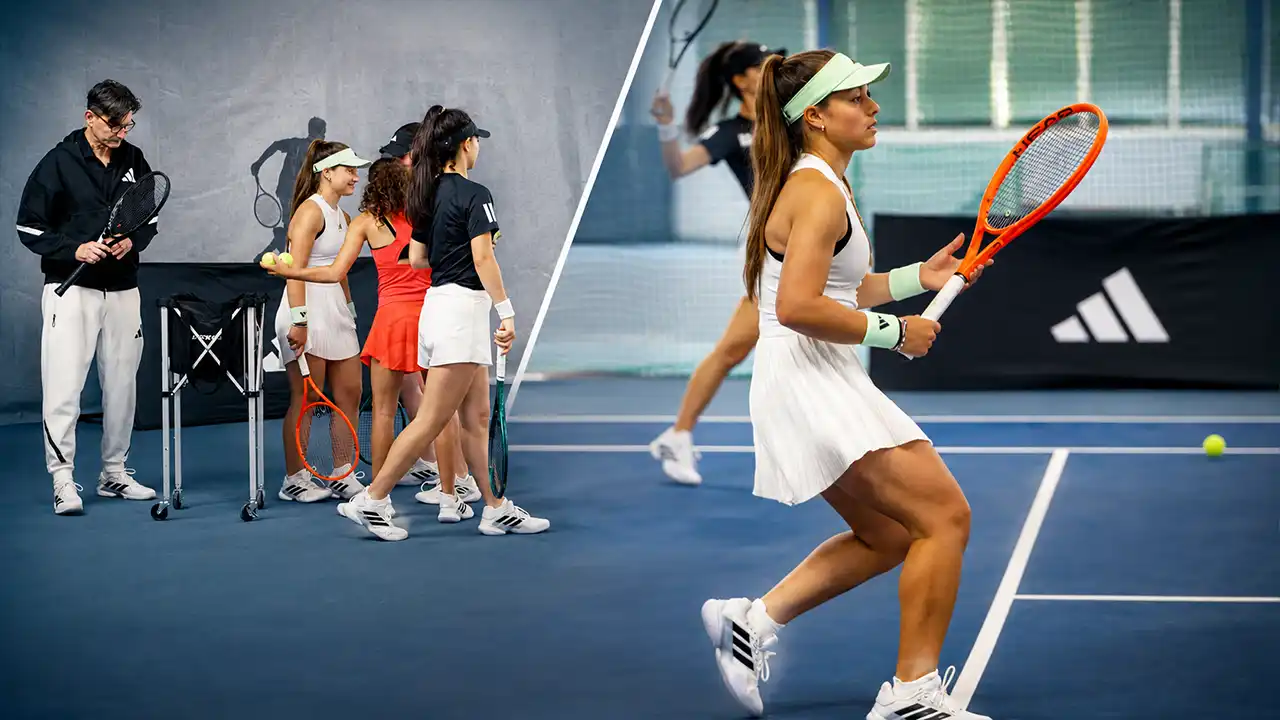
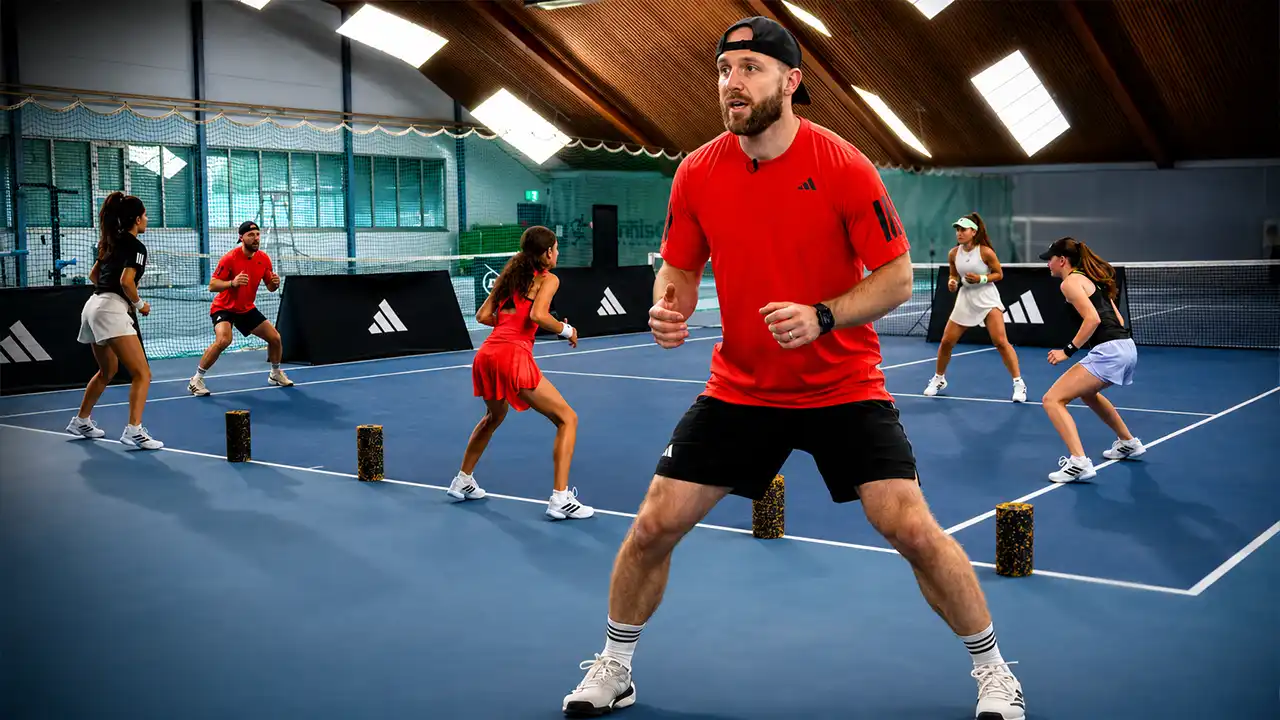
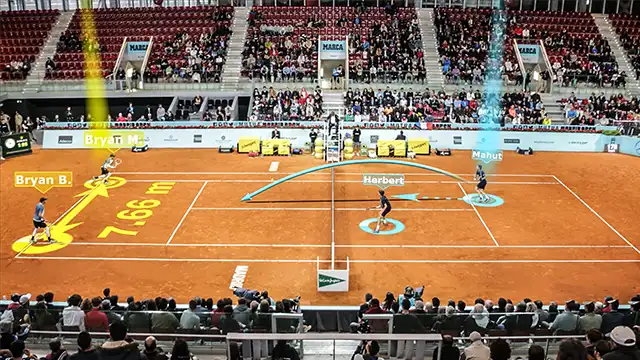
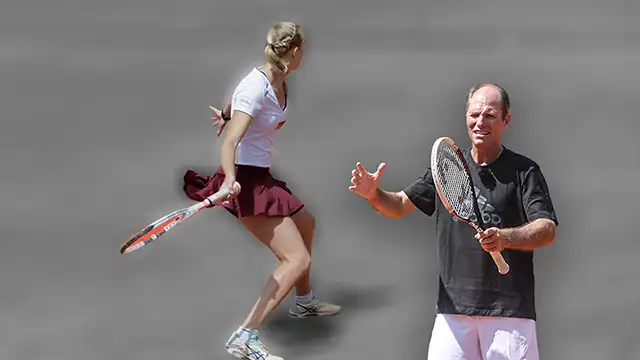
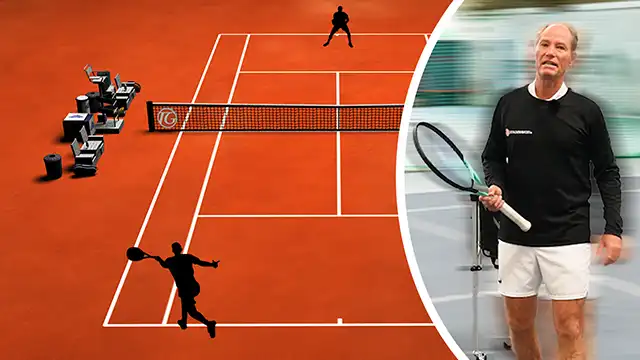
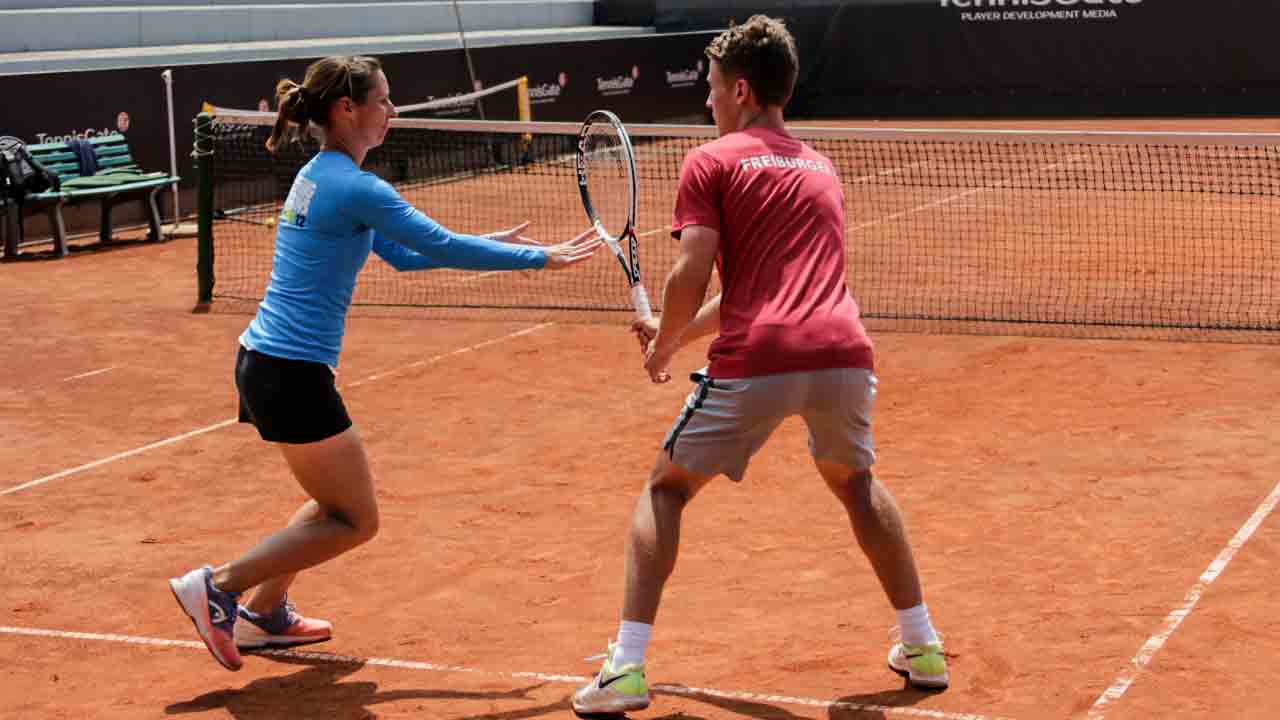
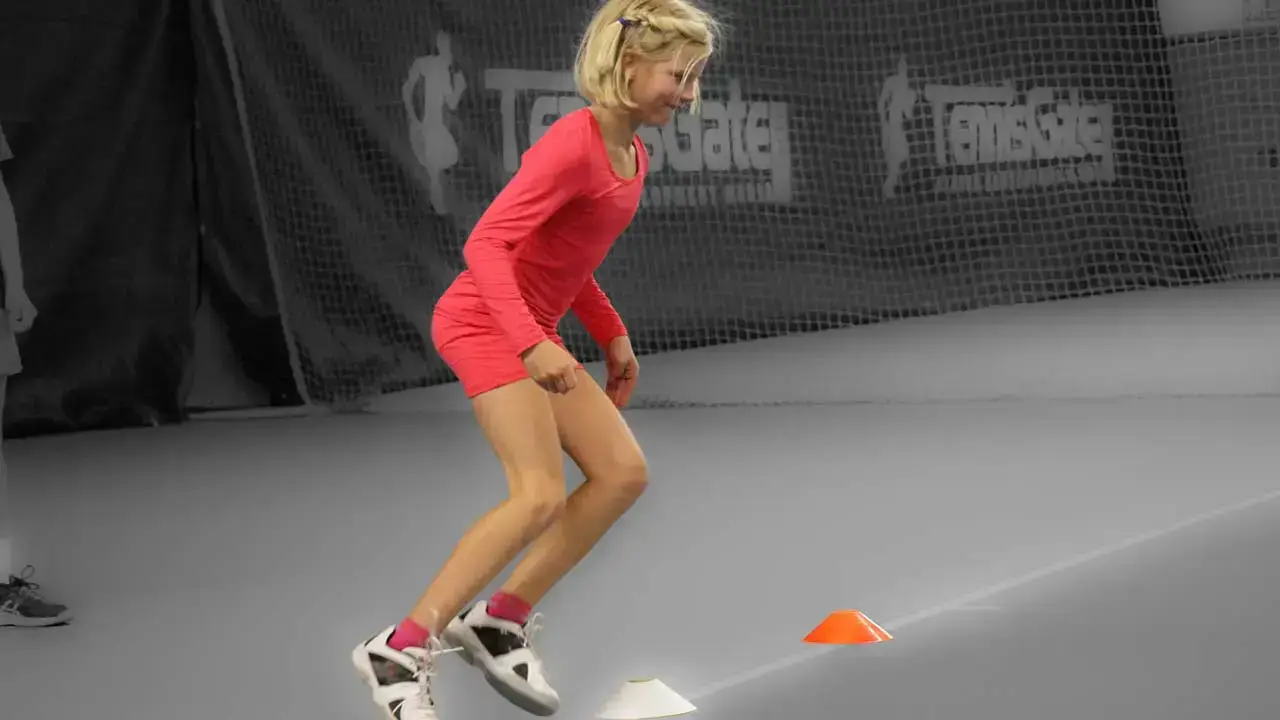
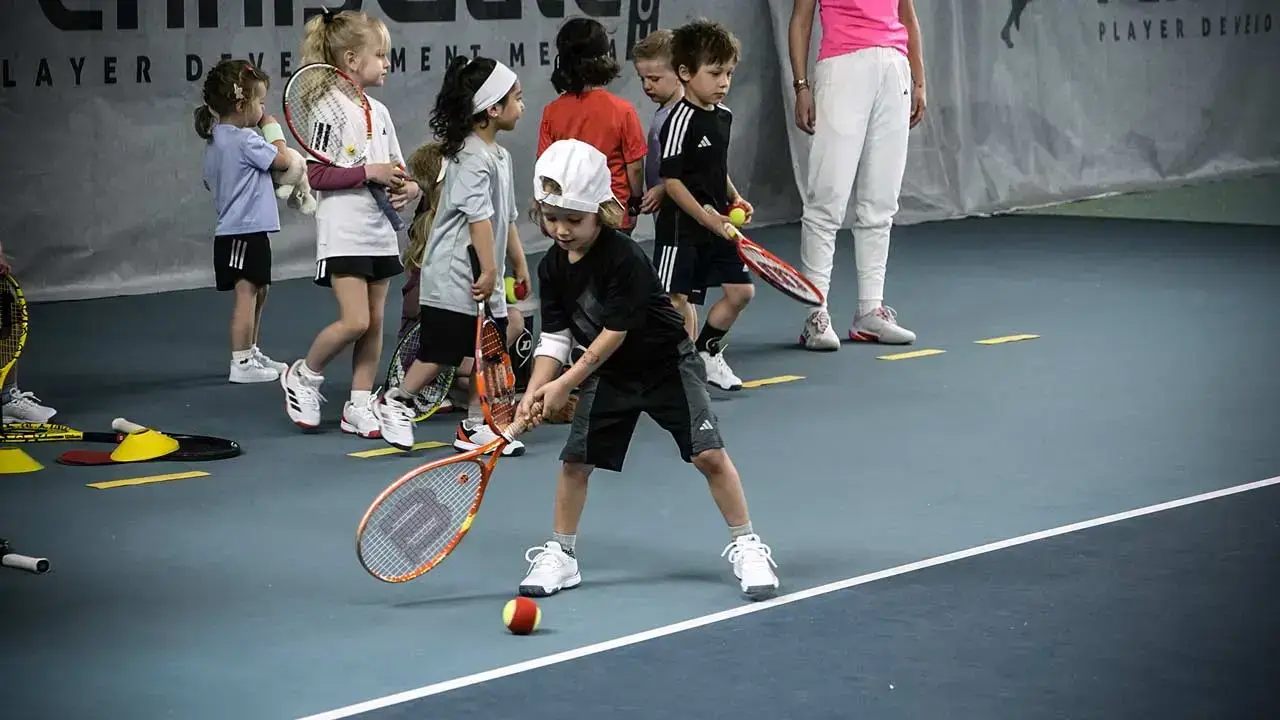
The players work in pairs on the mini tennis court. The ball is played over the net in a controlled way, initially without high pace and with the goal of building the rally in a stable way.
After each stroke, the player takes an active step over the line forward and then returns to the starting position. The point is not just to cross the line, but to push off the ground consciously. After the stroke, the step forward is executed, then the movement back behind the line follows.
The line serves as a clear reference. It shows whether the player is working actively forward after the stroke and whether she then returns to a stable starting position. The movement should remain rhythmic and controlled: hit, step over the line, come back, be ready again.
Training Goal
The goal of the exercise is to connect stroke rhythm and footwork. The players should learn to work actively after every stroke and not stay in the hitting position.
The exercise improves:
- Active push-off after the stroke
- Return to the starting position
- Connection between stroke and footwork
- Rhythm on the mini tennis court
- Balance after the contact point
- Orientation using a clear reference line
Coaching Keys
- Play in pairs on the mini tennis court.
- Take a step over the line after every stroke.
- Push actively off the ground.
- Then work back in a controlled way.
- Use the line as orientation.
- Don’t stop after the stroke.
- Connect the stroke with the forward-backward movement.
- After the stroke, cover the space again.
- Stay stable, even when the movement goes forward.
- First play in a controlled way, then increase the pace.
Load Management
The exercise works well as an introduction to a technical or coordinative mini tennis training session. Since stroke and footwork are combined, the load should first be kept short and controlled.
Recommendation:
- 3–5 rounds
- 30–60 seconds per round
- short break between rounds
- initially at moderate pace
- focus on movement quality
- only play longer or faster once the execution is stable
With younger players or if there are technical uncertainties, the exercise should first be done very slowly. What matters is that after each stroke there is actually a step over the line and a clean movement back.
Possible Corrections
The player stays standing after the stroke:
Consciously take a step over the line after every stroke. The line serves as a clear check.
The step over the line is too passive:
Push more actively off the ground. The movement should not just be placed, but really initiated.
The player does not come back:
After the step over the line, work directly back behind the line again. The next ball should be prepared from a stable position.
The upper body tips forward:
Keep an upright, stable body posture. The step forward should be controlled, not falling forward.
The rally gets too fast:
Reduce the pace. First stabilize the movement task, then increase the playing pace.
The player loses balance after the stroke:
Choose smaller steps and play the stroke more calmly. The movement should stay stable.
The footwork happens too late:
React directly after the stroke. The step over the line is part of the stroke finish and the preparation for the next ball.
Progressive Execution: from easy to difficult
1. Dry without a ball
The players practice the sequence without a ball: starting position, step over the line, come back. The focus is only on the movement.
2. With shadow movement
The players add a simple stroke movement without a ball. After each shadow movement, the step over the line and the movement back follow.
3. Slow mini tennis play
The players play in a controlled way on the mini tennis court. After every stroke, a step over the line is taken and then worked back again.
4. Clear forward movement after every stroke
The step over the line is made more active. The players make sure not just to step, but to push forward consciously.
5. More stable return movement
After the step over the line, the movement back is emphasized. The players return to a good ready position.
6. Higher playing rhythm
The pace on the mini tennis court is increased slightly. The task stays the same: hit, step over the line, come back.
7. Alternating between Forehand and Backhand
The players alternate between Forehand and Backhand. This makes the connection between stroke side, push-off, and return movement more demanding.
8. Tennis-specific application in the half court
The exercise is expanded from the mini tennis court to the half court. The players have a little more space and must organize the return movement more actively.