

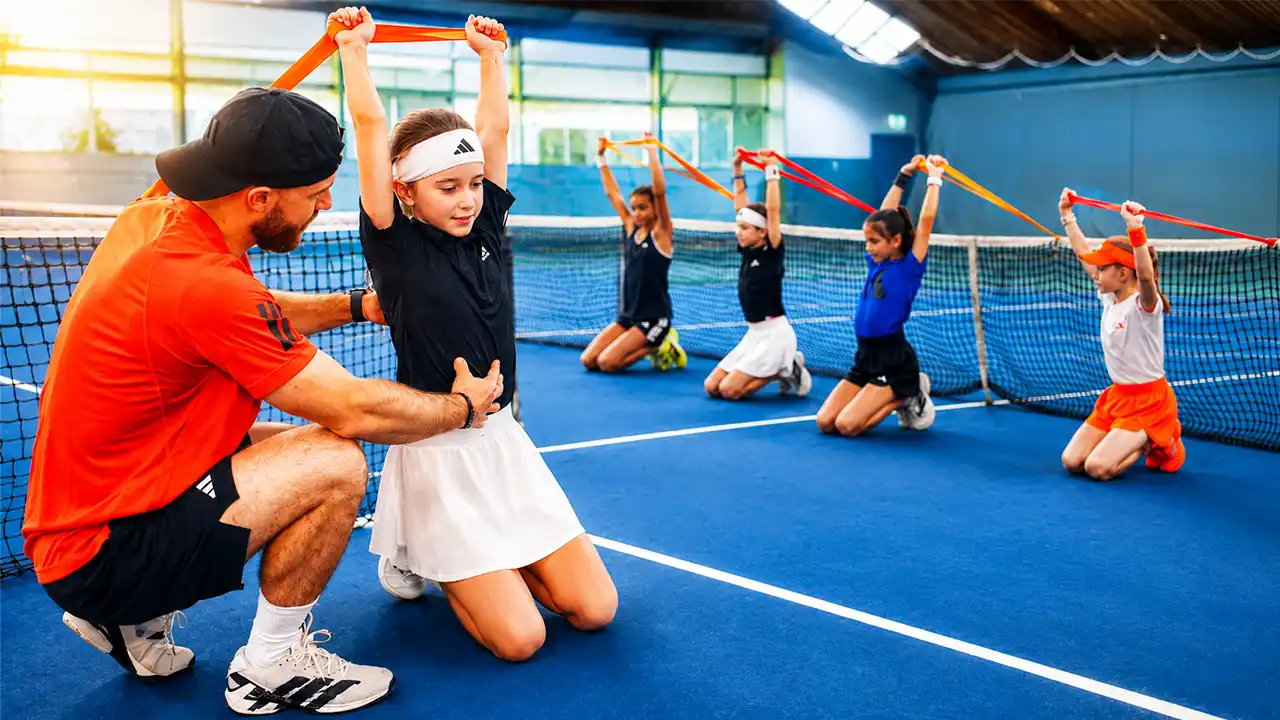



The children start in a kneeling position. The hips are guided back toward the heels, and the toes can be tucked under. In this position, the children hold an elastic band with both hands overhead. The arms stay straight, and the hands are behind the head or slightly behind the body line.
The band is actively pulled apart so that slight tension is created. From this stable starting position, the children slowly move the straight arms further back. The goal is to bring the arms as far behind the body as possible without compensating by arching the lower back.
The upper body stays controlled and upright, with a long spine. The ribs are actively pulled down so that the movement does not come from the lumbar spine, but is organized mainly through the shoulders, thoracic spine, and front body chain.
The arms are then guided back forward in a controlled way without losing the tension in the band or the stable body posture.
Transfer to tennis
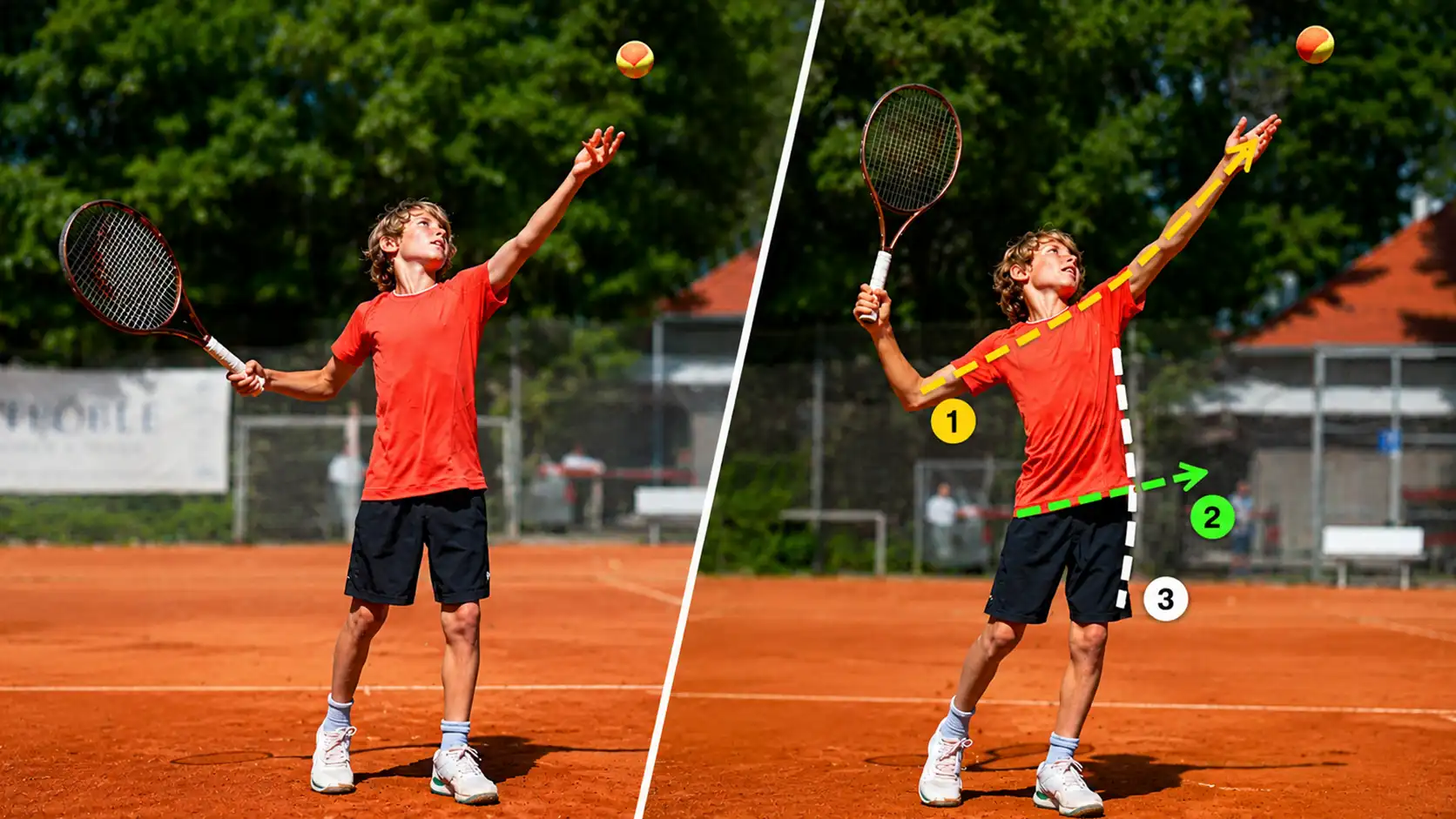
In tennis, shoulder mobility, core stability, and the ability to extend the upper body in a controlled way play a central role. Especially on the Serve, overhead movements, high balls, and athletic extension actions, the body must be able to take the arms overhead and behind the body line without losing control in the core.
This exercise improves exactly that connection: the children learn to move the shoulders freely while the core stays stable. That is an important foundation so that overhead movements can later be performed not only with more mobility, but also more cleanly, more economically, and with better load tolerance.
The key is not to get as far back as possible, but to perform the movement in a controlled way. Anyone who simply falls into a hollow back in the exercise is compensating through the lumbar spine. Anyone who actively keeps the ribs down and guides the arms cleanly back improves movement quality for tennis-specific actions significantly.
Training Goal
- Improving shoulder mobility in overhead position
- Mobilizing the thoracic spine
- Stretching the front body chain
- Training core stability during arm movements overhead
- Improving body alignment and extension ability
- Preparing for serve, overhead, and extension movements in tennis
- Avoiding compensatory movements through a hollow back
Load Management
For children, the exercise should be performed calmly, in a controlled way, and with clean technique.
Recommendation:
- 4 to 6 repetitions per set
- 2 to 3 sets
- slow movement tempo
- short hold in the stretched position
- no maximal load, but controlled movement quality
- enough rest between sets if body tension drops
The exercise is especially well suited as part of a mobility warm-up or as a preparatory exercise before serve, throwing, or overhead content.
Possible corrections
- If the children fall into a hollow back: actively pull the ribs down.
- If the arms bend: reduce band tension and make sure the arms stay straight.
- If the head moves forward or backward: keep the head in line with the spine.
- If the upper body tilts forward: have them straighten up and lengthen.
- If the shoulders are pulled up: keep the shoulders relaxed and control the movement.
- If the children work too fast: reduce the tempo and hold the end position briefly.
- If the movement comes only from the lower back: reduce the range of motion and secure core control.
Coaching Keys
- “Make yourself tall through the spine.”
- “The arms stay really straight.”
- “Pull the band slightly apart.”
- “Keep the ribs down.”
- “Don’t fall into a hollow back.”
- “Work through the shoulders, not the lower back.”
- “Keep the head straight.”
- “Guide the arms back slowly and come forward again in a controlled way.”
- “Feel the stretch, but stay stable.”
Progressive execution – from easy to hard
Step 1: Basic position without large reach
The children start kneeling with the hips on the heels. The band is held overhead, and the arms stay straight. First, it is only about finding the basic position: long spine, stable rib position, calm head.
Step 2: Small arm movement backward
The arms are guided only slightly behind the head. The range of motion stays small. The goal is to keep tension in the band and avoid compensating by arching the lower back.
Step 3: Larger recline with control
The children move the straight arms further back and try to feel a clear stretch in the shoulders and front body chain. The ribs stay actively down, and the core stays stable.
Step 4: Hold phase in the end position
A brief hold is kept in the back position. The children should breathe calmly, maintain tension in the band, and stabilize the upper body in a controlled way.
Step 5: Dynamic repetitions with clean return
The arms are guided backward and forward again in a controlled way. Movement quality is the focus: straight arms, stable center, no compensatory movement through a hollow back.
Variation:
Compared with the kneeling version, the standing variation requires significantly more full-body control. The children not only have to guide the arms straight overhead and back, but also keep the pelvis, ribs, and spine stable at the same time. It is especially important to consciously push the hips back and tilt the pelvis so that the movement is not compensated for through an escape in the lower back.