
When comparing the three most important serve variations, the flat serve and the slice serve show many similarities, while the kick serve differs more clearly in its movement pattern.
This becomes especially clear when the serves are placed directly next to each other and the respective swing paths of the racket to the ball are visualized. What matters for whether the ball is played without pronounced spin, with sidespin or with topspin is above all the direction in which the racket is brought to the ball and swung through the contact point.
Different ball toss positions can be useful here as a methodical learning aid: a ball toss placed a little further to the left can support learning the kick serve, while a ball toss a little further to the right can make the slice serve easier. Technically, however, these changes are not absolutely necessary.
An advanced player can develop different serve variations from a largely identical ball toss by changing above all the backswing and the swing path of the racket to the ball. This also makes the serve harder for the return player to read.
Key insight: The ball toss does not primarily determine the serve variation – what matters is how the racket swings to the ball.
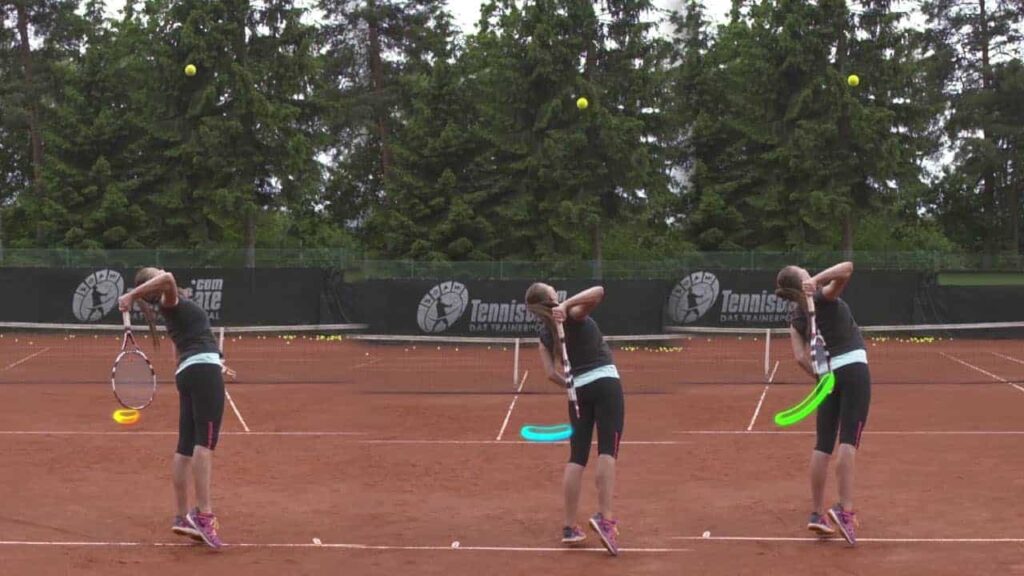
Comparison of swing paths
The recording of the swing path begins at the moment when the tip of the racket passes its lowest position and the upward movement to the ball starts. Even in this phase, clear differences between the three serve variations become visible – especially in the amount of upper-body rotation and in the direction from which the racket accelerates toward the ball.
In the Kick Serve (left), the player stays in a side-on position noticeably longer. The upper-body rotation has barely begun yet, and the swing path starts significantly further to the left. This allows the racket to accelerate more strongly from left to right and upward toward the ball.
In the Flat Serve (center), the upper-body rotation is already most advanced at this point. The swing path is oriented more strongly forward and toward the goal.
In the Slice Serve (right), the movement lies between these two variations: the upper-body rotation has already been initiated, but is not yet as advanced as with the flat serve. This allows the racket to approach the ball more from the side and create the desired sidespin.
Coaching Keys
- Kick: Hold the side-on position longer and accelerate the racket clearly from left to right upward toward the ball.
- Flat: Let the upper body rotate forward earlier and accelerate the racket more directly through the contact point.
- Slice: Initiate rotation in a controlled way and guide the racket through the contact point from a more sideways path.
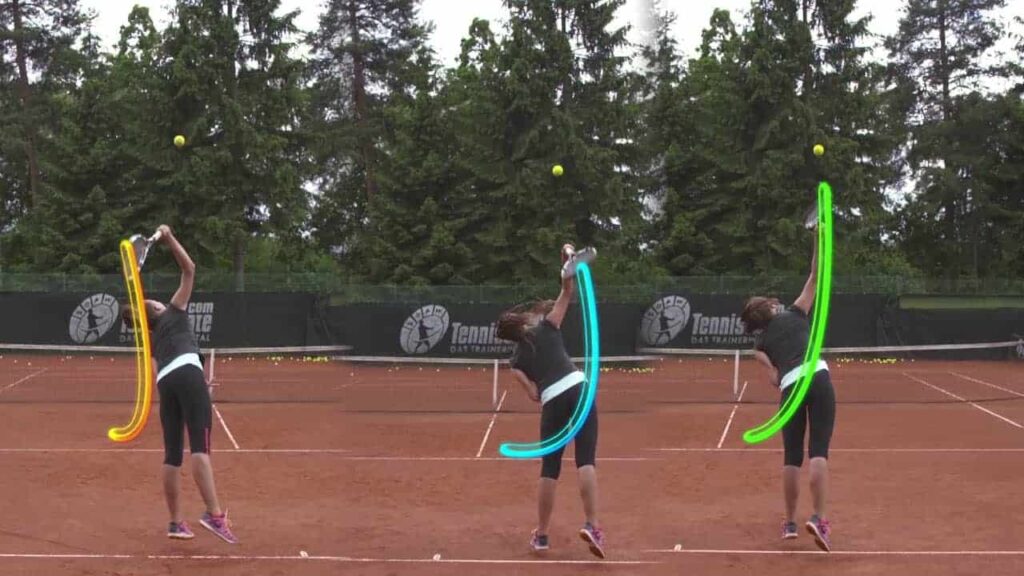
Racket backswing and upper-body rotation
As the legs push powerfully off the ground and the upward movement to the ball begins, clear differences in the position of the racket head relative to the body become visible. These differences show from which direction the racket accelerates toward the ball – and they are closely linked to the respective degree of upper-body rotation.
In the Kick Serve (left), the racket comes to the ball clearly from the left side of the body. To make this swing path possible, the upper body remains side-on longer and opens later accordingly.
In the Flat Serve (center), the racket swings much more directly from behind to the ball. For this, the upper-body rotation must already be further advanced: the body is more open and thus supports the more direct backswing toward the contact point.
In the Slice Serve (right), the racket also approaches the ball more from the left side at first. However, the upper-body rotation is already further advanced than in the kick serve, without reaching the degree of opening seen in the flat serve.
This reveals a central connection: The serve variation is primarily determined by the racket’s backswing and swing path to the ball. The degree of upper-body rotation is closely linked to this swing path and creates the conditions for the respective swing direction of the racket.
Coaching Keys
- First look at the racket path: What matters is from which direction the racket accelerates toward the ball.
- Organize rotation to match the swing path: Kick stays more side-on longer, Flat opens earlier, Slice is in between.
- Develop spin through the backswing: Don’t primarily change the ball toss, but adapt the racket path to the ball to the desired serve variation.
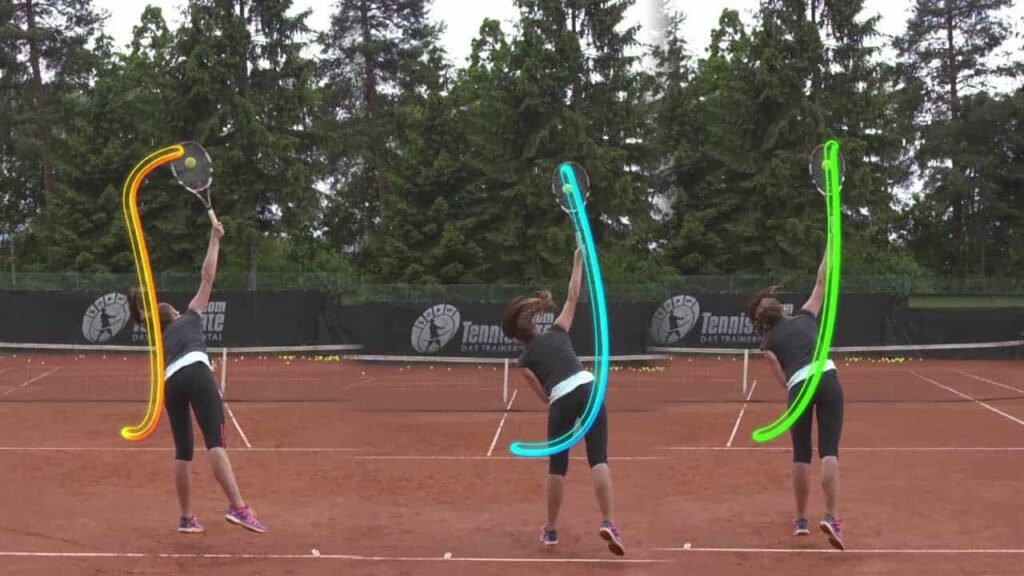
The contact point shows the decisive differences
The moment of contact is especially revealing, because this is where the different swing paths of the three serve variations become immediately visible.
In the Kick Serve (left), the racket swings clearly from left to the ball. Noticeable here is the visible angle between the hitting arm and the racket, which reflects the more sideways and upward-oriented racket path. At the same time, the upper-body rotation is less advanced – the side-on body position is maintained longer.
In the Flat Serve (center), the racket head is positioned almost directly behind the ball at contact. The racket moves much more straight through the contact point, while the upper body has already rotated noticeably further forward.
In the Slice Serve (right), the racket also approaches the ball more from the side. At contact, the racket face is aligned accordingly, allowing the racket to brush the ball from the side and create the desired sidespin. The upper-body rotation is more advanced than in the kick serve.
This also confirms the central connection at contact: racket path, alignment of the racket face and upper-body rotation work together and determine which flight and spin characteristics are imparted to the ball.
Coaching Keys
- Kick: Swing from left and upward to the ball – maintain the sideways body position for longer.
- Flat: Bring the racket as directly behind the ball as possible and accelerate more straight through the contact point.
- Slice: Attack the ball with a more sideways racket path and create sidespin through the appropriate racket face alignment.
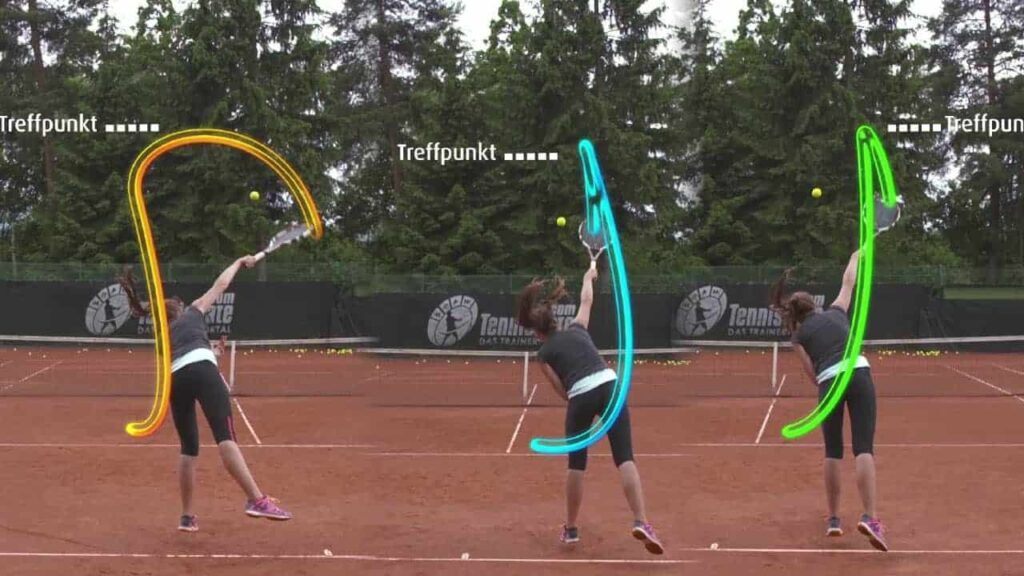
Swing path after the contact point
Even immediately after the contact point, the different swing directions of the three serve variations remain clearly visible.
In the Kick Serve (left), the characteristic swing path from left to right continues. After ball contact, the racket moves noticeably sideways, emphasizing the racket path through the contact point that is typical for the kick.
In the Flat Serve (center) and the Slice Serve (right), the racket follows the hitting and flight direction of the ball much more directly after the contact point. Despite the different racket alignment at contact, the two swing paths in this phase are more similar to each other than to that of the Kick Serve.
In these shots, the contact point of the straight serve is slightly lower. However, this is not a fundamental feature of the Flat Serve, but rather results here from the ball toss placed further forward. This allows the player to accelerate more strongly in the direction of the stroke and transfer more speed to the ball.
Coaching Keys
- Kick: Let the racket swing consistently from left to right through and after the contact point.
- Flat & Slice: Swing out more strongly in the hitting direction after ball contact.
- Do not view the contact point in isolation: Its position also depends on the ball toss and the intended acceleration direction.
Progressive adjustment – Level 3 and 4
This analysis is deliberately aimed at players in Level 3 and 4 of our development system. In Level 1 and 2, the focus is first on a functional serve movement, movement rhythm, a stable ball toss, and a reliable contact point. A detailed distinction between the swing paths for a straight serve, slice and kick would create additional complexity here before the necessary technical foundations are stable enough.
Level 3 – Developing spin variations
Now the deliberate change of the swing path becomes the central learning goal. Players learn to understand and feel how the racket must swing to the ball in order to produce a straight serve, slice, or kick.
Different ball toss positions can initially be used as a methodical support. At the same time, upper body rotation is increasingly adapted to the desired swing path. The key at first is a clear differentiation and secure control of the different racket paths.
Level 4 – Optimize serve variations and use them tactically
The swing paths developed in Level 3 are now produced from an increasingly similar preparation and a ball toss that is as similar as possible. The returner should remain unsure for as long as possible which serve variation is being played.
Swing path, upper body rotation, contact point and acceleration direction are specifically adapted to the tactical task. Straight serve, slice and kick are no longer only technically mastered, but are used deliberately to influence flight trajectory, speed, bounce height and the returner’s position, and to prepare the desired situation for Serve +1.
Progression Level 3 → Level 4:
Differentiate and control swing paths → disguise serve variations and use them tactically.
Key learning factor: Teach the swing path – don’t define the serve variation through the ball toss
The decisive technical difference between Kick, Flat and Slice is primarily created by the direction in which the racket swings to the ball, through the contact point and then continues. The different upper body rotation is closely linked to this swing path: It creates the spatial conditions for the racket to attack the ball from the desired direction.
For technique instruction, this means: instead of explaining the serve variations primarily through different ball tosses or isolated body positions, the player should first understand and feel how the racket must swing to the ball. The body organizes itself accordingly around this racket path.
Different ball tosses can be used as a methodical learning aid – for example further left for the kick or further right for the slice. However, the long-term goal should be to be able to play different serve variations from a ball toss that is as similar as possible.
The ball toss does not define the serve – the racket’s swing path does.
TennisGate Redaktion
Discover more content like this
Discover more coaching content and access the complete TennisGate library in the CoachesClub.