
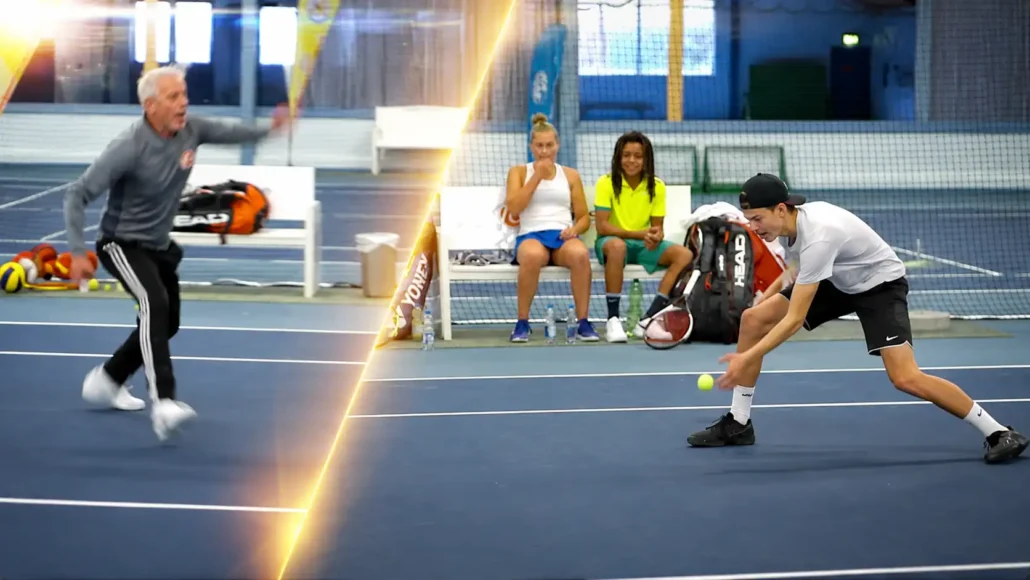
Two people play an intense catching-and-throwing duel against each other in a service box. The tennis ball is thrown directly from the hand from bottom to top over the net and must be caught by the person opposite before it touches the ground. By aiming throws into open spaces, the aim is to move the other player out of position and score a point. After each throw, it is therefore necessary to quickly reposition oneself favorably on the court and react to the next action. The small playing area creates short, explosive running paths, frequent changes of direction, and a constant switch between throwing, reacting, and catching. Since the load is very intense, a short game form is suitable, for example “Best of Five”.
Training Goal
- Activation of the cardiovascular system through short, intensive movement actions
- Improvement of reaction ability, first step acceleration, and quick changes of direction
- Training eye-hand coordination when catching and throwing accurately
- Development of perception and anticipation by recognizing and using open spaces
- Preparation for the tennis-like switch between explosive action and quick repositioning
Transfer to tennis
The special value of this game form lies in the combination of perceiving, deciding, and moving. It is not just about catching or throwing a ball. Before each action, you need to recognize where the other player is and which space is open. At the same time, after your own throw, the next defensive task must be prepared immediately.
This creates an action sequence typical of tennis: perceive the situation – make a decision – move explosively to the ball – execute the action – restore position.
Even though no tennis stroke is played, the movement demands are very tennis-like. Short bursts forward and to the side, braking movements, changes of direction, and quickly finding a favorable starting position again correspond to key demands of a rally. Because of the small playing area, the frequency of actions stays high and attention is constantly required.
Load Management
The exercise is much more intense than it first appears because of the small field and the direct switch between attack and defense. For that reason, the game phases should be kept deliberately short.
For the warm-up, “Best of Five” is a good option. Alternatively, short time intervals of about 20 to 30 seconds can be played. There should be enough rest between rounds so that the movements stay fast and controlled.
Several short, high-quality rounds are more useful than one long game phase, where reaction speed and movement quality gradually decline.
Coaching Keys
- Stay active: After your own throw, do not stand still, but immediately re-establish a favorable starting position.
- Recognize open spaces: Don’t just throw at the other player, but notice their position and deliberately play into open areas.
- Get to the ball quickly – brake in control: Start explosively, but regain body control before catching.
- Catch the ball safely: Actively guide the hands to the ball and take it in under control.
- Stay ready to move: An athletic basic position makes the first step in all directions easier.
Progressive Adjustment
At the beginning, the exercise can be played in a slightly larger area, with the ball allowed to bounce once. This gives the players more time to read the situation, move into position, and catch the ball. For a more challenging variation, reduce the playing area to one service box and require the ball to be caught before it bounces. This significantly reduces reaction time and increases the intensity and frequency of movement.
Another progression comes through tactical additional tasks. For example, players can be asked to deliberately play into different spaces or first move the other player with a throw in one direction and then use the resulting open space.
For stronger groups, the breaks between points can be reduced or several short sets can be played one after another. However, the quality of movement should take priority over maximum fatigue.
Possible Corrections
If a person stands still after their own throw, the focus should be on immediate repositioning. The point is not over with the throw – the next action starts right away.
If the player mainly throws directly at the other player, the task can be simplified: briefly notice the other player’s position before the throw and then deliberately play into the open space. This turns a pure catching-and-throwing task into a tactical perception task.
In case of hectic or uncontrolled movements, the speed should initially be reduced. A stable body position is especially important when braking and catching. The exercise should create intensive movement, but not uncontrolled hecticness.